

Structured Cabling Project Scopes: Real-World Examples

A structured cabling project scope is a formal document that defines every cable category, pathway responsibility, telecommunications room requirement, and documentation deliverable for a low-voltage installation. Without one, projects drift into change orders, trade conflicts, and retrofitting costs that dwarf the original budget. The examples of structured cabling project scopes covered here give project managers and IT coordinators a concrete reference for building scopes that hold up from site survey through final certification. Each example draws on TIA-568, TIA-569, and NEC Article 800 standards to reflect what commercial and institutional projects actually require.
1. What goes into a structured cabling project scope?
A cabling project scope defines the technical and administrative boundaries of the entire installation. The industry term for this document is a scope of work (SOW), and it covers six core subsystems: Entry Facilities, Equipment Rooms, Backbone Cabling, Horizontal Cabling, Telecommunications Rooms, and Work Areas. Understanding these subsystems is the first step toward writing a scope that leaves nothing ambiguous.
Every well-built SOW specifies cable categories with precision. Cat 6A is the established commercial standard for new office and institutional construction, supporting 10 Gbps up to 100 meters. Cat 5e is obsolete for new builds. Backbone runs typically call for OM4 multimode or OS2 single-mode fiber depending on distance and bandwidth requirements.
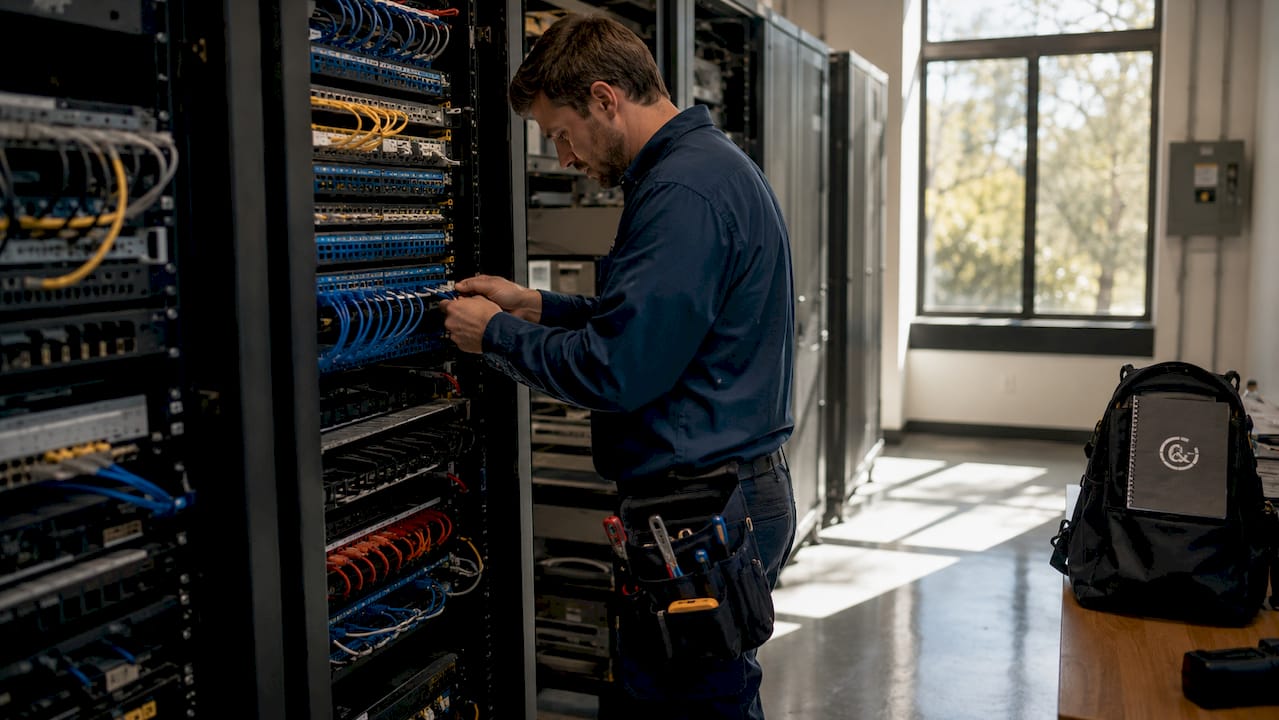
Telecommunications room (TR) specifications belong in every scope. TIA-569 recommends a minimum 10×11 foot footprint for each TR, with dedicated 120V circuits and temperature control between 65°F and 75°F. Scopes that omit TR sizing create conflicts with architects and general contractors during construction.
Grounding and bonding requirements per TIA-607-C and EMI separation distances per NEC Article 800 must also appear in the scope. NEC Article 800 requires a minimum 5-inch separation between structured cabling and fluorescent lighting or electrical sources. Missing this detail during planning produces expensive field corrections.
Pro Tip: Include the specific TIA and NEC standard numbers in your scope document. Referencing TIA-568-C.2 or NEC Article 800 by name gives the general contractor and AHJ a clear compliance baseline and reduces RFI volume.
2. Pathway ownership: the most disputed scope boundary
Electrical trades typically install primary pathways, including conduit and cable trays, while low-voltage contractors handle secondary supports, J-hooks, and termination boxes. When the scope does not state this explicitly, both trades assume the other is responsible. The result is duplicated work, missed installations, and costly change orders.
A clear scope lists every pathway type and assigns it to a specific trade. Primary conduit runs from the MDF to each IDF: electrical contractor. J-hook arrays above the ceiling grid from IDF to workstation drops: low-voltage contractor. Sleeves through fire-rated walls: general contractor, with low-voltage contractor responsible for firestop after cable pull.
Conduit sweep specifications also belong in this section. Outdoor plant (OSP) runs require burial depth callouts, conduit material specs (Schedule 40 PVC minimum for direct burial), and pull box locations. Multi-building campus scopes that omit these details routinely generate change orders during trenching.
3. Scope confirmation documents and documentation deliverables
A signed scope confirmation document listing cable runs, cable categories, and room numbers is the single most effective tool for controlling scope creep. Without a signed confirmation, contractors absorb unexpected field changes and the associated costs. The confirmation document is signed after the site survey and before material ordering.
Standard documentation deliverables in a structured cabling SOW include:
- CAD or Visio floor plan layouts showing cable routes, TR locations, and workstation drop coordinates
- Bill of materials (BOM) with manufacturer part numbers, cable categories, fire ratings (plenum vs. riser), and quantities
- Labeling plan conforming to TIA/EIA 606-B, including port IDs, panel IDs, and room designations
- Test and certification reports from a Fluke DSX or equivalent tester, showing pass/fail results for every link
- As-built drawings updated to reflect any field deviations from the original design
- Compliance matrix mapping each deliverable to the applicable TIA, NEC, or BICSI standard
Project milestones should tie directly to documentation completion. The scope should state that no cable pull begins until the floor plan layout is approved, and that final payment is contingent on delivery of test reports and as-built drawings.
Pro Tip: Require test reports in PDF format with the tester’s serial number and calibration date included. This protects both the client and the contractor if performance issues arise after occupancy.
4. Structured cabling scope examples across project types
Different environments produce different scope structures. The table below compares three common project types and the scope elements that distinguish them.
| Project Type | Cable Standard | Backbone | TR Count | Scope Complexity |
|---|---|---|---|---|
| Single-floor office | Cat 6A horizontal | OM4 fiber to MDF | 1 MDF | Low |
| Multi-floor commercial | Cat 6A horizontal | OM4 fiber, MDF + IDFs | 1 MDF, 2+ IDFs | Medium |
| Campus / multi-building | Cat 6A horizontal, OS2 OSP fiber | OS2 single-mode backbone | 1 MDF per building | High |
A single-floor office scope typically specifies two cable drops per workstation, one MDF, and Cat 6A horizontal cabling throughout. Conference rooms and executive offices receive four or more drops. The scope defines the MDF rack configuration, patch panel count, and labeling convention.
A multi-floor commercial scope adds IDF rooms on each floor connected to the MDF via OM4 fiber backbone. The scope must address riser pathway ownership, firestop requirements at each floor penetration, and the fiber strand count per run. Building cabling infrastructure in NYC often involves coordination with building management for riser access and conduit rights.
A campus or multi-building scope introduces OSP fiber, trenching specifications, and handhole locations. OS2 single-mode fiber is the standard for runs exceeding 300 meters. The scope must define who owns the trench, who supplies the conduit, and what burial depth applies under parking areas versus landscaped zones.
Scopes that include AV, CCTV, and access control must define clear boundaries between systems. Access control cabling requirements differ from data cabling in wire gauge, conduit fill, and power sourcing. Mixing these systems in a single scope line item without clear demarcation creates billing disputes and installation errors.
5. Common pitfalls in cabling project scopes and how to avoid them
The most frequent scope failures share a common root: ambiguity about who owns what. Defining pathway ownership between electrical and low-voltage subcontractors is the leading cause of change orders on commercial cabling projects. The fix is explicit language in the SOW, not verbal agreements during preconstruction meetings.
Key pitfalls and their corrections:
- Under-provisioning cable drops. Retrofitting cable drops post-construction costs $400–$800 per drop. Over-provisioning during the initial build is always the cost-effective choice. Scope at least two drops per workstation and four in conference rooms.
- Omitting site-specific constraints. Strong project proposals address site-specific physical constraints found during mandatory site walks. Ceiling height, existing conduit congestion, and asbestos abatement zones all affect cable routing and must appear in the scope.
- Fragmented low-voltage scopes. Separate planning for voice, data, security, and AV is required. When these systems share a single vague scope line, overlaps and gaps appear during installation.
- Late contractor involvement. Low-voltage contractors must be engaged before drywall closure. Pulling cable through finished walls costs multiples of the original installation price.
- Inconsistent documentation. Labor represents the largest cost in cabling projects. Poor labeling and missing as-built drawings eliminate the value of that labor investment within two years of occupancy.
“Mirroring client terminology and addressing site walk findings like ceiling height or pathway congestion in scopes significantly improves project outcomes.” — Structured Cabling RFP Template + Response Guide for Vendors
Scope confirmation sign-offs are non-negotiable. Every change after the confirmation document is signed becomes a formal change order with a price and schedule impact. This protects the contractor and gives the client full visibility into cost drivers.
Key takeaways
A well-written structured cabling scope defines cable categories, pathway ownership, TR specifications, and documentation deliverables before a single cable is pulled, preventing the change orders and retrofitting costs that derail most projects.
| Point | Details |
|---|---|
| Specify cable categories explicitly | Name Cat 6A, OM4, or OS2 with the applicable TIA-568 standard in every scope. |
| Assign pathway ownership by trade | State which contractor owns each pathway type to eliminate change orders. |
| Require a signed scope confirmation | Lock in cable runs and room numbers before ordering materials to control scope creep. |
| Over-provision cable drops | Retrofitting costs $400–$800 per drop; build in extra drops during initial construction. |
| Tie milestones to documentation | Make payment contingent on delivery of test reports and as-built drawings. |
What I’ve learned writing scopes for 40 years of cabling projects
The single biggest mistake I see on commercial cabling projects is treating the scope as a formality. Teams rush through it to get to the installation, and then spend the back half of the project arguing about who owes what. A scope that takes two extra days to write properly saves two weeks of field disputes.
The second lesson is about over-provisioning. Every project manager I’ve worked with has regretted under-provisioning drops. Nobody has ever regretted pulling an extra cable while the ceiling was open. The math is simple: a few hundred dollars of cable and labor during construction versus $400–$800 per drop after the fact. Write the extra drops into the scope and move on.
Cross-disciplinary coordination is where scopes most often fail silently. The electrical contractor assumes the low-voltage team is handling the J-hooks. The low-voltage team assumes the conduit is already run. Nobody checks until installation day. The fix is a coordination meeting with all trades before the scope is finalized, and explicit language in the SOW that leaves no room for assumption.
Finally, documentation is not a deliverable to negotiate away. Rack organization and labeling done right at installation time pays dividends for the life of the system. I’ve walked into server rooms five years after installation where the as-built drawings matched the physical plant exactly. That only happens when documentation requirements are written into the scope and enforced at closeout.
— Ken
How Cables supports your cabling project from scope to certification
Cables & Chips brings more than 40 years of structured cabling experience to commercial offices, secure facilities, and enterprise environments across New York City. Whether you are writing your first cabling project scope or managing a multi-building campus installation, Cables provides the technical depth and documentation discipline your project requires.
From Cat 6A installation and fiber optic backbone design to pathway coordination and TIA-compliant test certification, Cables handles every phase of the project. The team at 20 Vesey Street in Lower Manhattan is available for site surveys, scope reviews, and full installation services. Contact Cables & Chips to schedule a site survey and get a scope-ready proposal for your next infrastructure project.
FAQ
What is a cabling project scope?
A cabling project scope is a formal document that defines the cable categories, pathway responsibilities, telecommunications room specifications, and documentation deliverables for a structured cabling installation. It serves as the contractual and technical baseline for the entire project.
What cable standard applies to new commercial construction?
Cat 6A is the current commercial standard, supporting 10 Gbps up to 100 meters per TIA-568. Cat 5e is obsolete for new builds, and Cat 8 applies only to short-run data center applications.
How many cable drops should a scope specify per workstation?
A minimum of two drops per workstation is the accepted best practice. Conference rooms and executive offices typically require four or more drops, since retrofitting after construction costs $400–$800 per drop.
What documents should a structured cabling scope require at closeout?
Closeout deliverables should include CAD or Visio as-built drawings, a labeled bill of materials, TIA/EIA 606-B compliant labeling records, and Fluke DSX test certification reports for every installed link.
Why does pathway ownership matter in a cabling scope?
Undefined pathway ownership between electrical and low-voltage contractors is the leading cause of change orders on commercial cabling projects. Explicit scope language assigning each pathway type to a specific trade eliminates the ambiguity that drives rework and cost overruns.